TEXT → SHOT → SCHOLARSHIP · 2026-08-13
The Crystal-Image: How Actual and Virtual Exchange
Identifying the actual–virtual relation through the smallest circuit, the split of time, and crystalline states
Concept relation
- 01An actual image appears→
- 02Its contemporaneous virtual side arises→
- 03The two remain distinct and exchange positions→
- 04The split of time becomes visible
The crystal-image contracts an actual image and its contemporaneous virtual image into the smallest circuit. The two remain different in kind yet lose fixed assignability through exchange, making the passing present and the preserved past visible together.
Cinema 2 chapter 4 directly analyzes The Lady from Shanghai, Lola Montès, and Mirror. Comparisons with Mulholland Drive and the Pompeii scene are atlas analyses.
Primary coordinates
DELEUZE PRIMARY TEXTthe smallest internal circuit
FACT → RELATION → TEST
The smallest circuit preserves difference and removes fixed assignability
The crystal requires both actual–virtual difference in kind and unassignability within the circuit.The hall of mirrors in The Lady from Shanghai multiplies bodies, reflections, doubles, and deception in one field. A character's actuality is absorbed by mirror images, while reflections acquire visible actuality; neither side permanently owns the actual position.[1, pp. 68–69, 73, 76][4, pp. 119–133]
When gunfire shatters the mirrors, exchange stops with the proliferating circuit and bodies become locatable again. The mirrors perform and terminate a circuit; if they merely duplicate space, create symmetry, or symbolize narcissism, the crystalline test is not met.[1, p. 76]
FACT → RELATION → TEST
The crystal shows time splitting at every instant
The present must pass while becoming present and preserve itself as past.Mirror draws mother and wife, childhood and adulthood, perception and memory into a turning circuit; Deleuze calls it a turning crystal. Every present carries a contemporaneous virtual past rather than producing the past only after disappearing.[1, pp. 78, 82–84][3, pp. 70–73]
Lola Montès contracts the circus present and a life restaged for display into a closed circuit. The figure is both actual and performing her exhibited role in the same present, so preservation of the past and passage of the present occupy one crystalline milieu.[1, pp. 86–87]
FACT → RELATION → TEST
Crystalline states determine how the circuit continues
Shattering, enclosure, turning, and decomposition are formal states of the circuit that determine temporal direction, not mood labels.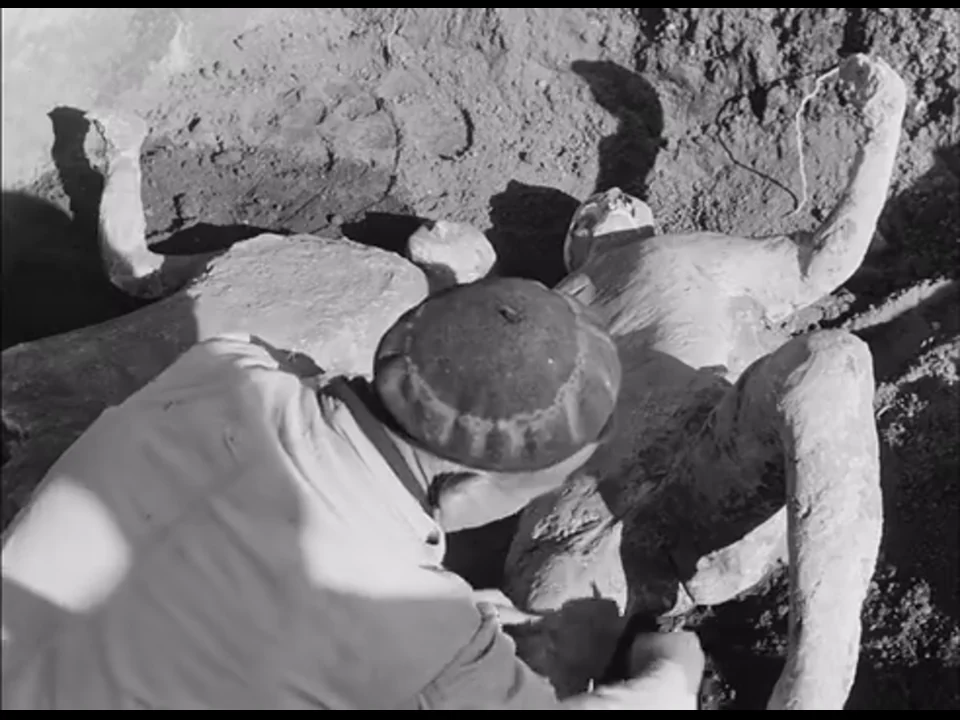
The technical operation successfully restores bodily contours while depriving the watching couple of their capacity to keep bearing the sight. Bilibili timecode 01:15:10.
Open scene evidenceMulholland Drive can be tested through the shot-chain in which Betty/Diane, audition/performance, and wish/memory rewrite one another. The blue box, mirrors, or dream motif cannot decide the relation alone; the circuit and its turns must be mapped.
The Pompeii passage contracts an archaeological present and a past death into one sequence, yet the layers remain assignable: workers belong to the current operation and casts to the revealed past. It is a boundary case showing that temporal compression is not actual–virtual exchange.[3, pp. 68–76]
Film comparisons
The Lady from Shanghai
Shattered crystalThe hall multiplies actual and virtual; shattered mirrors terminate the circuit.
Lola Montès
Perfect crystalThe circus present encloses and restages a life as a circuit of display.
Mirror
Turning crystalFigures, ages, and memory positions exchange as the crystal turns from within.
Mulholland Drive
Identity-circuit testReciprocal rewriting of figure, performance, and memory tests a contemporary crystal.
How scholarship advances the problem
Paola Marrati
Gilles Deleuze: Cinema and PhilosophyPlaces the crystal within Deleuze's ontology of time and explains how it displays temporal splitting.
Used to distinguish the crystalline relation from psychological memory.Open full citation ↓Ronald Bogue
Deleuze on CinemaSystematizes the hyalosign, crystalline states, and their director-specific cases.
Used to build a two-stage analysis of minimal circuit and change of state.Open full citation ↓References
- 01
DELEUZE PRIMARY TEXT Gilles Deleuze, Cinema 2: The Time-Image, trans. Hugh Tomlinson and Robert Galeta (University of Minnesota Press, 1989).
Chapter 4, pp. 68–87Publisher record and purchase access - 02
DELEUZE PRIMARY TEXT Gilles Deleuze, Cinema 3 seminar, Lecture 18 (15 May 1984) and Lecture 19 (22 May 1984), Purdue archive.
Lecture 18 English transcript, pp. 3–5; Lecture 19, pp. 12–13Open audio and transcripts - 03
SCHOLARSHIP Paola Marrati, Gilles Deleuze: Cinema and Philosophy (Johns Hopkins University Press, 2008).
Chapter 5, “The Time-Image,” pp. 68–76Publisher record and purchase access · DOI 10.56021/9780801888021 - 04
SCHOLARSHIP Ronald Bogue, Deleuze on Cinema (Routledge, 2003).
Chapter 4, “Hyalosigns / Crystalline States,” pp. 119–133Publisher record and preview