TEXT → SHOT → SCHOLARSHIP · 2026-08-13
Sensory-Motor Rupture: How a Character Becomes a Seer
From the gap between completed movement and an unmastered situation to pure optical-sound situations and direct time
Concept relation
- 01Perception meets a situation beyond its existing schema→
- 02Movement continues but remains inadequate to the situation→
- 03Sight and sound are no longer exhausted by reaction→
- 04The seer receives direct time
Sensory-motor rupture occurs when perception may still lead to completed movement, yet action is no longer adequate to the situation. The seer receives sights and sounds that no response exhausts, and time becomes the pressure of the image rather than the measure of action.
Cinema 2 directly discusses Germany Year Zero, Journey to Italy, Europa '51, and the postwar seer. The perception–action–consequence analysis of individual scenes is this atlas's shot analysis.
Primary coordinates
DELEUZE PRIMARY TEXTa cinema of the seer
FACT → RELATION → TEST
The act is completed; the situation remains unmastered
Rupture occurs between local motor success and the failure of the action-chain as a whole.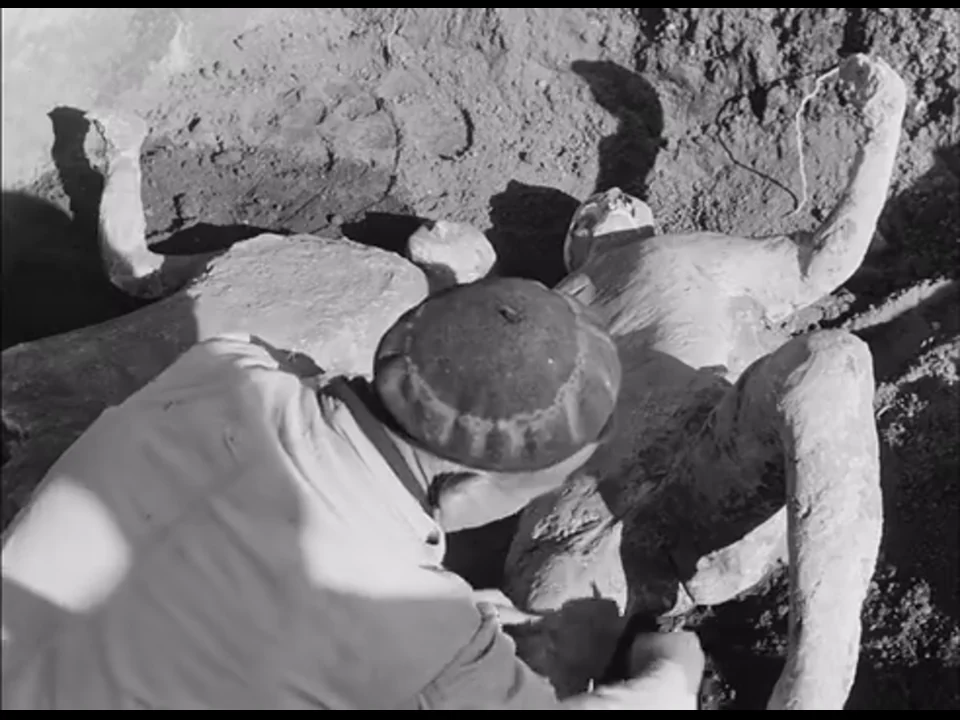
The technical operation successfully restores bodily contours while depriving the watching couple of their capacity to keep bearing the sight. Bilibili timecode 01:15:10.
Open scene evidence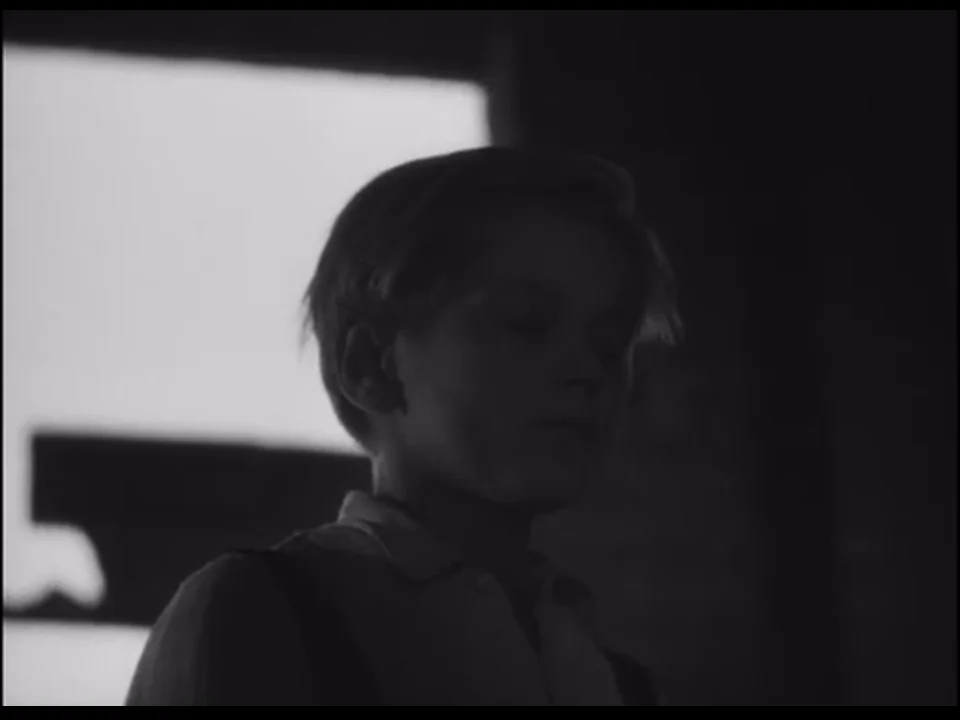
The long wandering turns streets, church, ruined buildings, traffic, and children's play from usable action-space into a city layer that must be watched. Bilibili timecode 01:12:18.
Open scene evidenceThe archaeological procedure at Pompeii succeeds: casting, clearing, and identification make two bodies visible. Katherine cannot extend what she sees into an act capable of treating her marriage. The more exact the technical operation, the clearer the inadequacy of personal action.[1, pp. 2–3]
In the final movement of Germany Year Zero, Edmund keeps walking, stopping, picking up, looking, and climbing. Each movement is completed, yet none repairs his father's death, restores the family, or opens a next step. Movement remains; its extensible bond with the world does not.[1, p. 2][3, pp. 58–60]
In Europa '51, machines, workers, rollers, and passages no longer form an environment awaiting Irene's management. The factory bears down on her with prison-like intensity, turning an organizer of life into someone learning to see.[1, pp. 2, 21, 46–47][4, pp. 107–113]
Marrati locates the postwar turn in a changed relation between image and action: reality no longer appears as a situation to be mastered, and seeing acquires autonomous value. The seer is produced by the situation rather than predetermined by a passive character type.[3, pp. 57–61]
FACT → RELATION → TEST
The image unexhausted by action carries time
When the shot no longer submits to route and task, pressures of past, present, and future can coexist within one passage.The long wandering turns streets, church, ruined buildings, traffic, and children's play from usable action-space into a city layer that must be watched. Bilibili timecode 01:12:18.
Open scene evidence
Photographs, black screen, and a second title sequence headed 'A Spirit's Path' sever the everyday love story of the first half. Bilibili timecode 00:58:55.
Open scene evidenceThe ending of Germany Year Zero brings the continuable present of children's play, the uncleared past of fascist sound, and the immediate past of the father's death to bear on wandering at once. The route turns none of these tenses into a solvable problem; time organizes seeing before purpose does.
After Tropical Malady's second intertitle, blackout, tiger image, and forest sound cut the first movement's romantic actions and redistribute the visible and audible. This carries the test beyond European postwar periodization: wherever a passage releases sights and sounds from motor command, the problem of the seer can be posed anew.
Film comparisons
Journey to Italy
Technical success / personal inadequacyThe Pompeii operation succeeds while Katherine's marital action cannot extend.
Germany Year Zero
Movement persists / future closesWalking and climbing are completed but no longer generate a continuable world.
Europe ’51
The factory forces seeingIndustrial space escapes the housewife's managerial schema and acquires visual intensity.
Tropical Malady
A reset of the audio-visual regimeThe forest after the intertitle tests the seer beyond the postwar corpus.
How scholarship advances the problem
Paola Marrati
Gilles Deleuze: Cinema and PhilosophyRecasts the postwar break as a reorganization of reality, action, and subjectivity.
Used to distinguish the seer's receptivity from outward passivity.Open full citation ↓Ronald Bogue
Deleuze on CinemaProvides a stepwise account of opsigns, sonsigns, and sensory-motor rupture.
Used to turn shot facts into a repeatable three-part test.Open full citation ↓References
- 01
DELEUZE PRIMARY TEXT Gilles Deleuze, Cinema 2: The Time-Image, trans. Hugh Tomlinson and Robert Galeta (University of Minnesota Press, 1989).
Chapter 1, pp. 2–5Publisher record and purchase access - 02
DELEUZE PRIMARY TEXT Gilles Deleuze, Cinema 3 seminar, Lecture 9A, 24 January 1984, Purdue Deleuze Seminars.
English transcript, pp. 7–9Open English transcript PDF - 03
SCHOLARSHIP Paola Marrati, Gilles Deleuze: Cinema and Philosophy (Johns Hopkins University Press, 2008).
Chapter 4, “Postwar Cinema,” pp. 57–61Publisher record and purchase access · DOI 10.56021/9780801888021 - 04
SCHOLARSHIP Ronald Bogue, Deleuze on Cinema (Routledge, 2003).
Chapter 4, “Opsigns,” pp. 107–113Publisher record and preview