TEXT → SHOT → SCHOLARSHIP · 2026-08-13
Fabulation: How the Speech Act Prefigures a People to Come
Tracing an unfinished collective through double becoming, material consequences, and collective enunciation
Concept relation
- 01Characters tell and reenact their situation→
- 02Character and filmmaker change one another's position→
- 03Speech alters roles, resources, and labour→
- 04Collective enunciation prefigures a people to come
Fabulation produces reality through storytelling. Character and filmmaker become intercessors; private experience enters politics; speech changes roles, labour, resources, and authority. These visible effects produce collective enunciation and prefigure a plural, unfinished people to come.
Cinema 2 chapters 6 and 8 directly discuss Pour la suite du monde, Moi, un noir, and Black God, White Devil. Scene timecodes, visible facts, and consequences of speech come from this atlas's shot analysis; The Hour of the Furnaces compares another starting point for political cinema.
Primary coordinates
DELEUZE PRIMARY TEXTC’est l’appel à son peuple.
FACT → RELATION → TEST
Fabulation is a double becoming
Real characters become other through storytelling, while their intervention changes the filmmaker's position.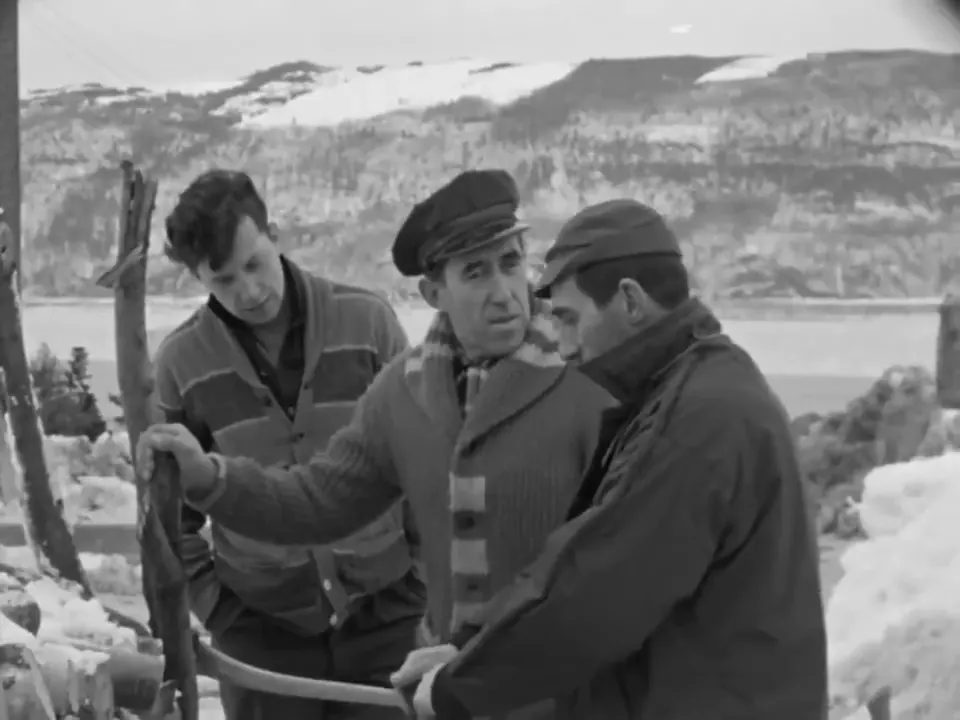
Preparations for the beluga hunt begin with a riverside discussion.
Open scene evidenceIn Moi, un noir, assumed names, postsynchronized voices, and urban experience rewrite one another. Characters no longer supply material for a prior ethnography; through narration they perform and produce new subject positions, changing Rouch's authorial position through free indirect discourse.[1, pp. 156, 230][3, pp. 135–164]
The first discussions in Pour la suite du monde transform a long-interrupted beluga hunt from elders' memory into a shared object. Perrault proposes the revival, while islanders provide knowledge, disagreement, and labour; neither side alone determines what the film will produce.[1, pp. 150–153][4, pp. 202–226]
FACT → RELATION → TEST
The speech act is evidenced by real consequences
An utterance acquires efficacy when it changes participants, resources, tasks, labour, or authority within the film.Preparations for the beluga hunt begin with a riverside discussion.
Open scene evidence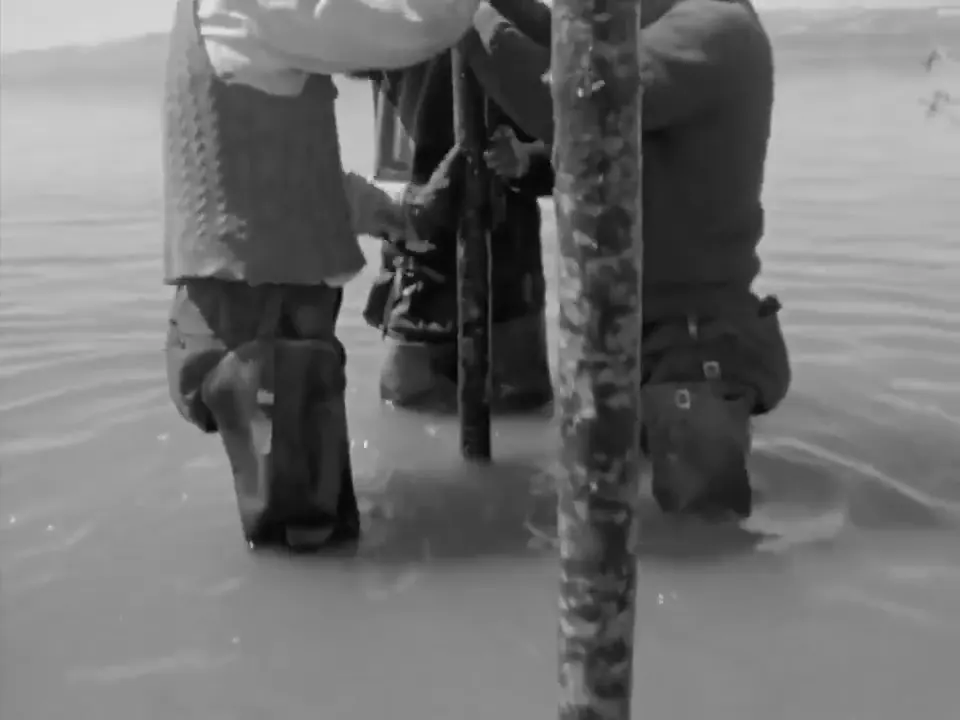
Deliberation, roles, and materials become shared construction in the water.
Open scene evidence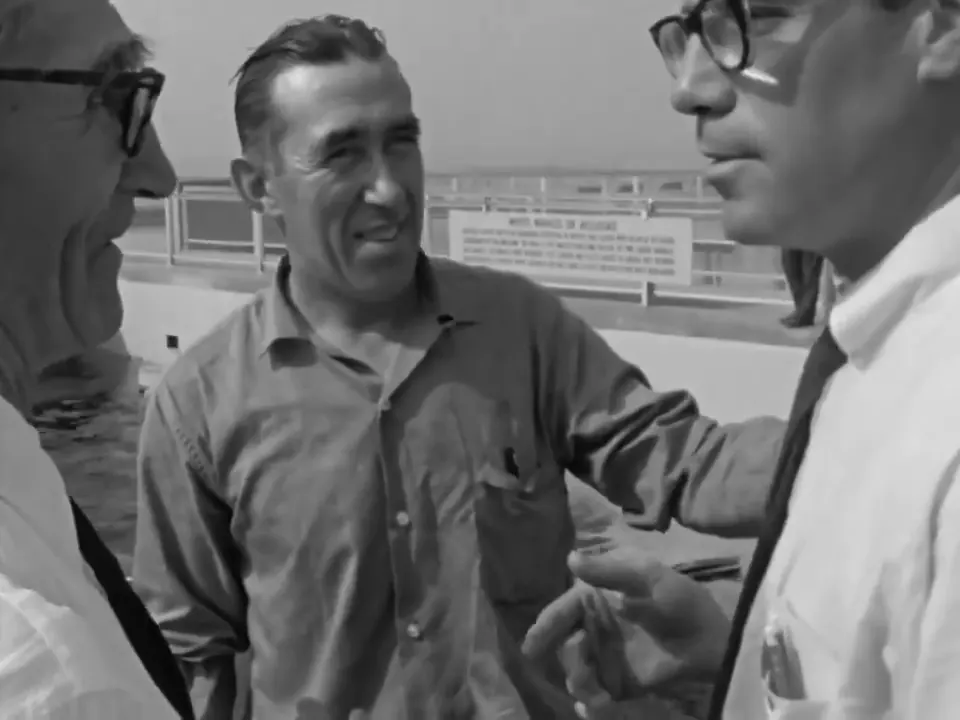
The group delegates one member to speak for them inside an institutional setting.
Open scene evidenceElders speak knowledge of tides, posts, and beluga; islanders form a plan through discussion, obtain equipment through financing, and set posts in the tide. Speaker, addressee, circulation, and collective labour occupy one timeline, so speech enters a material assemblage.[1, pp. 150–153][4, pp. 202–226]
At the aquarium, the group explicitly delegates one person to speak on its behalf. An individual voice acquires a plural source and public capacity; authority is not conferred by voice-over but produced by a traceable act within the group.[1, pp. 150–153]
FACT → RELATION → TEST
Collective enunciation prefigures a people to come
A plural speaking position forms through disagreement, relay, response, and delegation; the people remains minor, unfinished, and future-facing.In Black God, White Devil, myth, trance, and changing allegiance expose the people's absence. Figures move among religious leader, bandit, peasant, and myth; the collective is not completed before the film begins, and absence becomes a condition of creation.[1, pp. 225, 229]
The montage, intertitles, pauses, and discussions of The Hour of the Furnaces directly address a revolutionary audience. This essay uses it as an atlas comparison: it begins with public address, while Perrault and Rouch film a collective speaking position taking form through speech.
Film comparisons
Pour la suite du monde
Memory enters plan and labourStorytelling, financing, setting posts, and delegation form a traceable speech-act chain.
Moi, un noir
Characters become through voiceAssumed names, postsynchronized voices, and urban experience produce new subject positions.
Black God, White Devil
The missing people as creative conditionMyth, trance, and changing allegiance keep the collective unfinished.
The Hour of the Furnaces
A presupposed revolutionary addresseeBegins from an addressable people, contrasting with a speaking position generated inside the film.
How scholarship advances the problem
Ronald Bogue
Deleuze on CinemaConnects powers of the false, Rouch's ethnofictions, and modern political cinema.
Used to distinguish character storytelling from external representation.Open full citation ↓Ronald Bogue
Fabulation, Narration and the People to ComeProvides a focused account of fabulation, narration, and the people to come.
Used to construct the full chain from double becoming to collective enunciation.Open full citation ↓References
- 01
DELEUZE PRIMARY TEXT Gilles Deleuze, Cinema 2: The Time-Image, trans. Hugh Tomlinson and Robert Galeta (University of Minnesota Press, 1989).
Chapter 6, pp. 150–156; chapter 8, pp. 215–230Publisher record and purchase access - 02
DELEUZE PRIMARY TEXT Gilles Deleuze, Cinema and Thought seminar, Lecture 12, 5 February 1985, Purdue archive.
Around 114:00, fabulation and the peopleOpen audio, French transcript, and English translation - 03
SCHOLARSHIP Ronald Bogue, Deleuze on Cinema (Routledge, 2003).
Chapter 5, especially “Powers of the False” and “Rouch's Ethnofictions,” pp. 135–164Publisher record and preview - 04
SCHOLARSHIP Ronald Bogue, “Fabulation, Narration and the People to Come,” in Deleuze and Philosophy (Edinburgh University Press, 2006), pp. 202–226.
pp. 202–226DOI and publisher chapter access · DOI 10.1515/9780748627196-016